.svg)
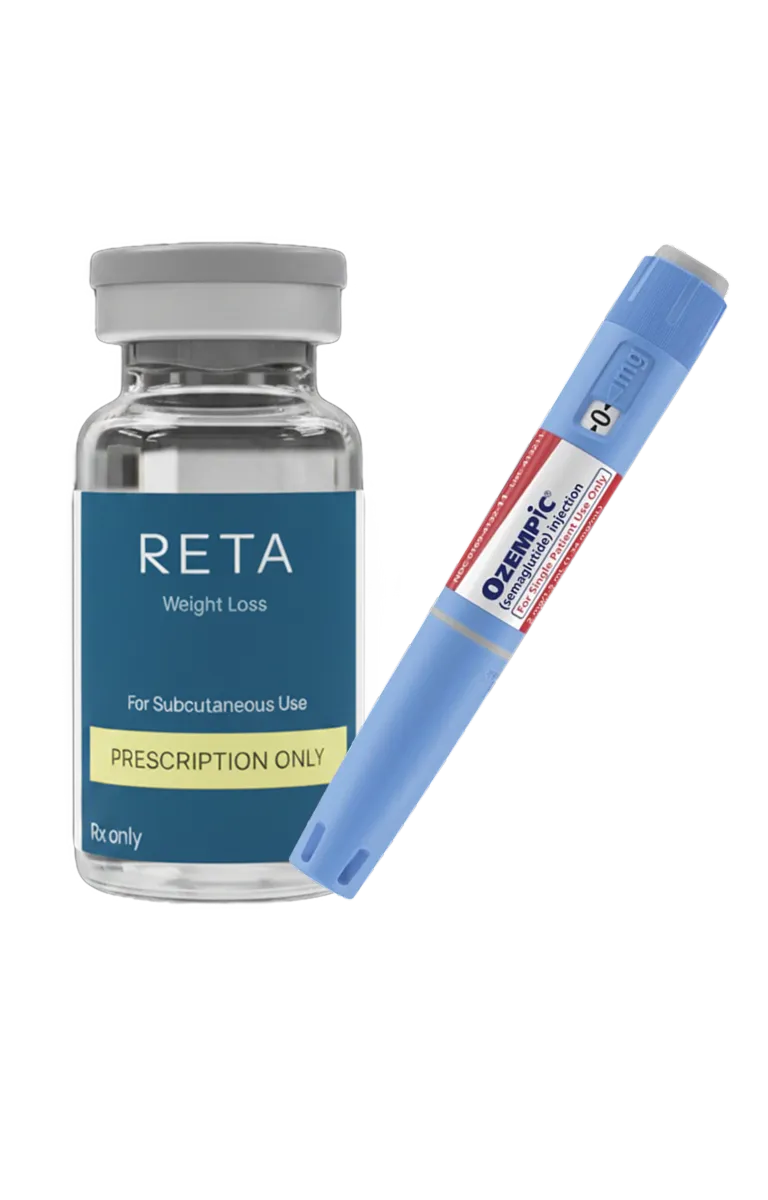
Retatrutide vs Semaglutide (Ozempic): 28.7% vs 15% (2026 Data)
Triple vs single agonist mechanisms, safety, availability. Which is better? 2026 update.
Introduction
Ozempic and Wegovy — both semaglutide — are the drugs that made GLP-1 medications a household conversation. Wegovy producing 14.9% average weight loss in its Phase 3 trial was, at the time, the most effective obesity medication ever approved.
Then retatrutide posted 28.3% in TRIUMPH-1 and 28.7% in TRIUMPH-4 — nearly double. That gap is the question this article addresses: not just how large it is, but why it exists, whether it matters clinically, and what it means for someone already on semaglutide today.
The short answer on availability: semaglutide is FDA-approved and available by prescription. Retatrutide won't be available until 2027–2028 at the earliest. For most people, that timing gap is the most important number in this comparison.
Quick Comparison
Clinical Trial Results: What the Data Actually Shows
Retatrutide — TRIUMPH Phase 3 Program
Retatrutide has completed two Phase 3 trials in obesity populations, both showing nearly identical results despite different patient populations and durations — which is exactly what a robust efficacy signal looks like.
TRIUMPH-4 (December 2025)
TRIUMPH-1 (May 21, 2026)
Semaglutide — STEP-1 Trial
What Nearly Double the Weight Loss Means in Practice
For a patient starting at 250 lbs:
These numbers come from separate trials with different populations — not a direct head-to-head comparison.
The difference is substantial. A 250-lb patient on semaglutide lands at roughly 213 lbs. The same patient on retatrutide lands at roughly 179 lbs — a BMI trajectory that changes downstream health outcomes, surgical candidacy, and cardiovascular risk in meaningfully different ways.
The responder rate gap is even more striking than the average. Just 12% of semaglutide patients in STEP-1 achieved ≥25% weight loss. That same threshold was reached by 58.6% of retatrutide patients in TRIUMPH-4. For severe obesity specifically, these are not comparable outcomes.
Mechanism: Why One Drug Does Nearly Twice the Work
Semaglutide is a GLP-1 receptor agonist. That's the entire mechanism: activate GLP-1, reduce appetite, slow gastric emptying, stimulate insulin. One receptor, one pathway.
Retatrutide's GIP component improves tolerability and insulin sensitivity. Its glucagon component is what creates the performance gap. Semaglutide reduces how much you eat. Retatrutide does that plus activates glucagon receptors that increase how many calories you burn at rest — a genuinely additive mechanism that GLP-1 alone cannot replicate.
The glucagon component is also what explains retatrutide's most distinctive side effect: dysesthesia (abnormal skin sensations) in 12.5–20.9% of patients depending on trial, which is not seen with semaglutide or any other approved weight loss medication.
Safety and Side Effects: Where Semaglutide Holds an Advantage
The safety comparison has two distinct parts: the side effect profile during treatment, and the long-term safety picture.
During Treatment
GI side effects — nausea, diarrhea, vomiting, constipation — are a class-level effect of GLP-1 activation and are similar between these two drugs. Both cause nausea in approximately 40–44% of patients at their respective highest doses. Both improve after the initial escalation period.
The meaningful differences are:
Dysesthesia: Semaglutide causes essentially none. Retatrutide causes it in 12.5–20.9% of patients depending on trial population. It's typically mild and doesn't usually lead to discontinuation, but it's real and unique to retatrutide.
Discontinuation rates:
Semaglutide has a meaningfully better tolerability profile. More people stay on it. TRIUMPH-1's 11.3% represents an improvement over TRIUMPH-4's 18.2%, and suggests the general obesity population tolerates retatrutide better than the older, more comorbid OA population in TRIUMPH-4. But even 11.3% is higher than semaglutide's 6.9%.
Long-Term Safety
This is where the comparison is most lopsided in semaglutide's favor — and it's important to be honest about it.
Semaglutide has been used by millions of patients since 2021 for weight loss, and since 2017 in its lower-dose diabetes form (Ozempic). The long-term safety picture, including the cardiovascular outcomes data from the SELECT trial (20% reduction in major cardiovascular events in patients with obesity and established CVD), is established.
Retatrutide's longest Phase 3 data is 80 weeks for TRIUMPH-1 (plus a 104-week extension in a BMI ≥35 subgroup). That's not long-term data by the standards of chronic disease management. The body of real-world pharmacovigilance that exists for semaglutide does not yet exist for retatrutide.
This is not an argument against retatrutide — it's an argument for honest timelines. By the time retatrutide reaches pharmacies in 2028, it will have longer data than semaglutide had at its 2021 approval. But it won't have five years of real-world use.
The TRIUMPH Trial Program: Where Retatrutide Stands
TRIUMPH-1 and TRIUMPH-4 form the primary efficacy package for the NDA filing, which is expected in Q4 2026. TRIUMPH-2 data will support a combined obesity-and-diabetes indication. TRIUMPH-Outcomes is not required for initial approval but will eventually provide the cardiovascular outcomes data that semaglutide already has from SELECT.
Availability: The Number That Determines Most Decisions
Semaglutide (Wegovy): FDA approved June 2021. Available at pharmacies now. NovoCare direct-pay program from $199/month; commercial insurance often covers with prior authorization; Medicare GLP-1 Bridge covers through December 2027 at $50/month copay.
Retatrutide: Not approved. NDA submission expected Q4 2026. FDA review through 2027. Earliest commercial launch Q1–Q2 2028.
For a patient with obesity-related complications who needs treatment in 2026 or 2027, the practical answer to "Ozempic or retatrutide?" is: Ozempic, because retatrutide isn't available.
Who Should Choose What
Start semaglutide (Wegovy) now if:
You need treatment today. Your weight-related health conditions — hypertension, prediabetes, sleep apnea, joint pain — benefit from treatment now rather than 18+ months from now. You want an FDA-approved medication with 5+ years of safety data and established insurance pathways. You need 10–15% weight loss, which is often sufficient to meaningfully improve metabolic risk, blood pressure, and joint function.
Consider waiting for retatrutide if:
You have severe obesity (BMI ≥40) and specifically need the difference between 15% and 28%+ weight loss — a gap that matters clinically when 15% still leaves you in a high-risk range. You've already tried semaglutide and achieved inadequate results; retatrutide's GIP and glucagon components offer genuinely different mechanisms. You can wait until 2028 without clinical harm.
The most practical approach for many patients:
Start semaglutide now. Begin losing weight and improving metabolic health. When retatrutide receives FDA approval in 2027–2028, reassess: if you've met your health goals, stay on semaglutide. If you need more, consider switching with physician guidance.
For a complete picture of the broader GLP-1 landscape including tirzepatide, see our three-way comparison of retatrutide, tirzepatide, and semaglutide.
For the full retatrutide approval timeline and what comes next, see our complete retatrutide guide.
Conclusion
The weight loss gap between retatrutide and semaglutide is real, mechanistically explained, and consistent across two Phase 3 trials. Nearly double the average weight loss is not a rounding difference — it reflects what adding GIP and glucagon receptor activation does on top of GLP-1.
But the gap in availability is equally real. Semaglutide is available now, has been used safely in millions of patients for years, and has cardiovascular outcomes data that retatrutide won't have for years. For most patients reading this in 2026, starting semaglutide now is a better clinical decision than waiting 18+ months for a drug that isn't approved.
Retatrutide's time comes in 2028, and specifically for patients who need more than semaglutide can deliver.
Sources
- Wilding JPH, Batterham RL, Calanna S, et al. "Once-Weekly Semaglutide in Adults with Overweight or Obesity." New England Journal of Medicine. 2021;384(11):989-1002. (STEP-1)
- Lincoff AM, et al. "Semaglutide and Cardiovascular Outcomes in Obesity without Diabetes." New England Journal of Medicine. 2023. (SELECT trial)
- Jastreboff AM, Kaplan LM, Frías JP, et al. "Triple-Hormone-Receptor Agonist Retatrutide for Obesity — A Phase 2 Trial." New England Journal of Medicine. 2023;389(6):514-526.
- Jastreboff AM, Kaplan LM, Frías JP, et al. "Retatrutide Phase 3 for Obesity: TRIUMPH-4 Results." New England Journal of Medicine. December 2025.
- Eli Lilly press release: TRIUMPH-1 Phase 3 topline results. May 21, 2026.
- Eli Lilly press release: TRIUMPH-1 and TRANSCEND-T2D-1 results, ADA 86th Scientific Sessions. June 6, 2026.
- FDA: Approval of Wegovy (semaglutide 2.4mg) for chronic weight management. June 4, 2021.
Frequently Asked Questions
Yes, Retatrutide shows 93% better weight loss than Semaglutide (28.7% vs 14.9%) in Phase 3 trials. However, Retatrutide is investigational and won't be available until 2027-2028, while Semaglutide is FDA-approved with 5+ years of proven safety data. For most people, Semaglutide is the better choice since it's accessible today with excellent results.
Retatrutide is not FDA-approved and won't be available until 2027-2028 at the earliest. Expected timeline: NDA filing Q4 2026, FDA review in 2027, possible approval late 2027, market launch 2028. If you need treatment now, Semaglutide (Wegovy/Ozempic) is FDA-approved and available immediately.
Retatrutide is a triple agonist (GLP-1/GIP/Glucagon) delivering 28.7% weight loss but is investigational with higher discontinuation (11.3–18.2% depending on trial). Semaglutide is a single agonist (GLP-1 only) delivering 14.9% weight loss, is FDA-approved, available now, and has the best treatment retention (93% complete therapy successfully).
Yes, switching may be possible when Retatrutide receives FDA approval (2027-2028). However, most people achieving 12-17% weight loss with Semaglutide experience significant health improvements and may not need to switch. Discuss with your doctor whether the potential additional 10-15% weight loss justifies new titration, higher discontinuation risk, and insurance challenges.
Related Topics
Evidence-based articles to support your journey toward sustainable health.
.webp)

.webp)

Register your interest in Retatrutide
Retatrutide is currently not available, but once it is approved, you’ll be the first to get notified. Sign up now and stay informed.
Simple one-time sign-up
Early access to availability updates
Exclusive status among the first users
Advantage over non-registered users
Disclaimer: This is not medical advice. Retatrutide is investigational and not FDA-approved. Consult your doctor. Full Medical Disclaimer.