Summarize the blog with AI
How Many People Reached a Lower BMI on Retatrutide? The Short Answer
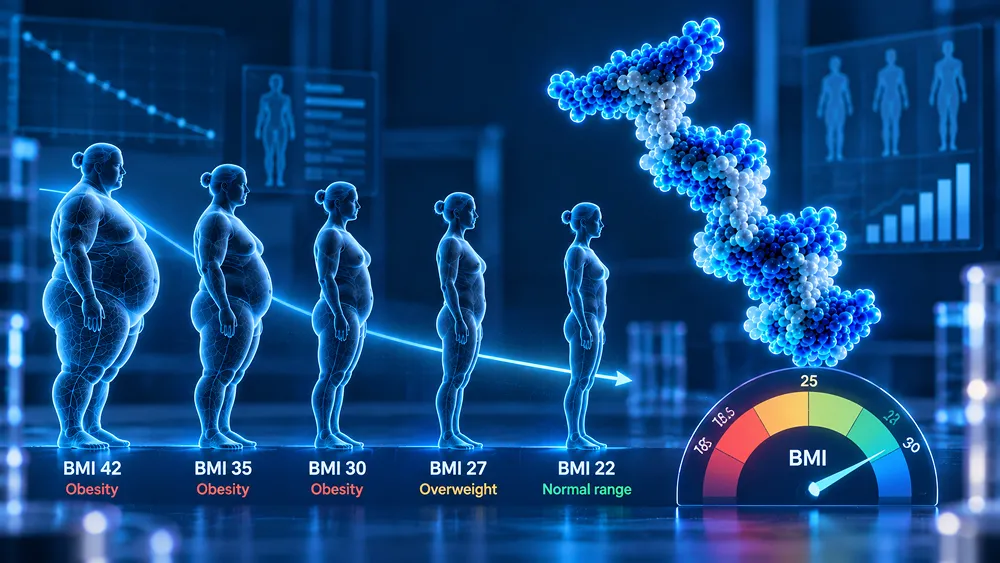
In the Phase 3 TRIUMPH-1 trial, participants started with an average body mass index (BMI) of 40. After 80 weeks on retatrutide 12 mg, 57.1% had a BMI below 30, the usual cut-off for obesity, and 26.3% had a BMI below 25, the upper limit of the normal-weight range, counting everyone randomized whether or not they stayed on treatment. On placebo, the figures were 9.2% and 1.6%.
If the drug had been taken as intended, an estimated 65.3% on 12 mg would have reached a BMI below 30 and 33.3% a BMI below 25. Results differed sharply by starting BMI, in observed data for participants still on their assigned treatment at week 80:
- Starting BMI 30 to 35 (class 1 obesity): more than 90% of those on 9 mg or 12 mg ended below 30, and about 60% below 25.
- Starting BMI 40 or more (class 3 obesity): about 38% of those on 12 mg ended below 30, and about 11% below 25.
These figures come from the TRIUMPH-1 paper, published in the New England Journal of Medicine in September 2026, and its supplementary appendix. The overall trial results are in TRIUMPH-1 results.
Who Was in the Trial: An Average BMI of 40
TRIUMPH-1 randomized 2,339 adults without diabetes who had a BMI of at least 30, or 27 to 30 with at least one weight-related condition, to retatrutide 4 mg, 9 mg or 12 mg or placebo for 80 weeks. Enrollment was weighted toward higher BMI: the average was 40, and 77.4% of participants had a BMI of 35 or more. Only 2% started with a BMI below 30, which the authors list as a limitation for applying the results to that group.
The BMI categories used in the trial's appendix are:
- Normal weight: BMI below 25
- Overweight: 25 to below 30
- Class 1 obesity: 30 to below 35
- Class 2 obesity: 35 to below 40
- Class 3 obesity: 40 or more
Retatrutide BMI Results by Dose
The trial also tracked a waist-to-height ratio below 0.5, a measure of fat around the waist. The table shows the estimated share of all participants who reached each target at 80 weeks, with two estimands, two ways of counting people who stopped treatment or started other weight-loss treatments, explained in why retatrutide weight loss numbers differ.
"Everyone randomized" is the treatment-regimen estimand, which counts every participant whether or not they stayed on treatment. "As intended" is the efficacy estimand, which estimates the result had everyone taken their assigned treatment for the full 80 weeks without starting other weight-loss treatments. The figures are model-based estimates; the BMI targets were not part of the trial's formal testing for multiple comparisons. Average weight loss behind these results was 25.0% on 12 mg counting everyone randomized and 28.3% as intended.
BMI Results by Starting BMI
The appendix also shows which BMI category participants were in at week 80, separately for each starting category. These are observed results, without imputation, for participants who were still on their assigned treatment and had not started other weight-loss treatments by week 80. People who stopped treatment are left out, which probably makes the results look better than for everyone randomized, and fewer people remained on placebo than on retatrutide, so these figures are not directly comparable with the table above.
The "below 30" figures are our sums of the overweight and normal-weight shares shown in Figure S9 of the appendix. On 4 mg, 79.5% of those starting in class 1, 50.0% in class 2 and 8.4% in class 3 ended below 30.
Two other changes stand out in the same figure. On placebo, 18.8% of those who started in class 1 had moved up to class 2 by week 80, and 11.0% of those in class 2 had moved up to class 3; none of those on 9 mg or 12 mg moved up a category (on 4 mg, 2.7% of those in class 1 did). The paper's discussion says that no participants on retatrutide moved from class 1 to class 2; in the appendix figure, that holds for 9 mg and 12 mg. And among people starting with class 3 obesity, 14.0% on 12 mg were still in class 3 at week 80, against 78.8% on placebo.
In the subgroup with a starting BMI of 35 or more, with an average of 42.3, 49.0% reached a BMI below 30 and 19.7% a BMI below 25 on 12 mg, counting everyone randomized (56.7% and 25.1% as intended), against 2.5% and 0% on placebo.
When BMI Reached 22 or Below: Dose Reductions in the Trial
The trial protocol allowed doses to be permanently reduced if a participant's BMI fell to 22 or below or if the participant or investigator considered the weight loss excessive, among other reasons such as gastrointestinal side effects. According to the paper and its appendix (Table S1):
- BMI of 22 or below: led to a dose reduction in 2.6%, 6.0% and 5.5% of participants on 4 mg, 9 mg and 12 mg, against 0.3% on placebo.
- Perceived excessive weight loss: led to a dose reduction in 2.7%, 6.7% and 9.8%, against none on placebo.
- Stopping treatment: 0.3%, 1.0% and 5.3% stopped because of perceived excessive or sufficient weight loss, against none on placebo.
Whether these weight changes came mostly from fat or from muscle was not reported in the paper or its appendix; what is known is covered in retatrutide muscle loss.
The Authors' View: Treating to a BMI Target
In their discussion, the TRIUMPH-1 authors write that "these data support the possibility of treating to a defined target," as is done with blood sugar targets in type 2 diabetes, "rather than to a relative percent change in weight." They add that BMI and waist-to-height ratio "do not fully define obesity" but "provide a first step toward a treat-to-target approach," and that more studies are needed to define targets linked to health outcomes.
This is the authors' proposal, not a tested approach. TRIUMPH-1 gave fixed doses and measured how many people reached each BMI category; it did not test adjusting treatment to reach a target BMI.
How the Results Differed by Sex
The appendix does not report BMI targets separately for women and men. It does show that women appeared to lose a larger share of their body weight than men at every retatrutide dose (26.3% against 22.3% on 12 mg, counting everyone randomized), as covered in retatrutide weight loss in women vs men.
What Is Still Unknown
- Results in people starting below a BMI of 30, who were only 2% of participants.
- What happens to BMI after stopping, covered in weight regain after stopping retatrutide.
- Whether reaching a given BMI on retatrutide lowers the risk of health outcomes. The trial measured BMI categories, not long-term outcomes.
Retatrutide Sold Online: Why the Trial Data Don't Apply
Retatrutide is not approved and, according to its developer, is legally available only through clinical trials; its regulatory position is tracked in retatrutide approval status. The company says anything sold to consumers outside those trials is illegal, and warns that illicit retatrutide products may contain "unknown ingredients, harmful contaminants and impurities." The results above come from a controlled trial in which participants received the study drug under medical supervision.
Sources
- Jastreboff AM, Kaplan LM, Davies MJ, et al. Retatrutide, a Triple Hormone Receptor Agonist, for Treatment of Obesity. N Engl J Med. Published September 29, 2026; updated October 22, 2026. DOI: 10.1056/NEJMoa2604169. Supplementary Appendix: Figures S8, S9 and S11, Tables S1, S6 and S7. (TRIUMPH-1)
- Eli Lilly. What to know about retatrutide. Last updated September 2026.
Medical Disclaimer: This article is for informational purposes only and is not medical advice. Retatrutide is investigational and is not approved by the FDA for any use. It is not available by prescription, and Lilly says anything sold to consumers under its name outside its clinical trials is illegal. The figures described here are those reported in clinical trials under medical supervision.
Frequently asked questions
In the Phase 3 TRIUMPH-1 trial, participants started at an average BMI of 40. After 80 weeks on retatrutide 12 mg, 57.1% had a BMI below 30 and 26.3% below 25, counting everyone randomized, against 9.2% and 1.6% on placebo. If the drug had been taken as intended, the estimated figures on 12 mg were 65.3% and 33.3%.
In TRIUMPH-1, 12.0%, 24.5% and 26.3% of participants on 4 mg, 9 mg and 12 mg reached a BMI under 25 at 80 weeks, counting everyone randomized, against 1.6% on placebo. Among those who started with a BMI of 30 to 35 and were still on their assigned treatment at week 80, 61.1% on 9 mg and 58.3% on 12 mg ended under 25.
In TRIUMPH-1, among participants who started with a BMI of 40 or more and were still on their assigned treatment at week 80, 38.3% of those on 12 mg ended with a BMI below 30 and 10.7% below 25, against under 1% on placebo. On 12 mg, 14.0% were still at a BMI of 40 or more, against 78.8% on placebo.
The TRIUMPH-1 protocol allowed the dose to be reduced if BMI fell to 22 or below. This happened in 2.6%, 6.0% and 5.5% of participants on 4 mg, 9 mg and 12 mg, against 0.3% on placebo. Dose reductions for perceived excessive weight loss occurred in 2.7%, 6.7% and 9.8%, and in none on placebo.